Crypto in 2026 and the 2027 cycle plan that targets millions with a staged altcoin allocation
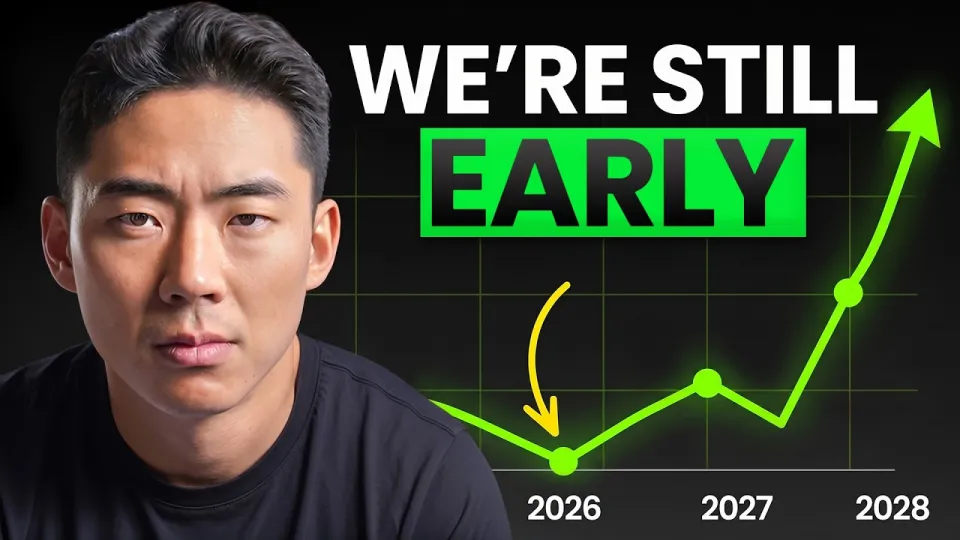
Video: my plan to make millions in crypto 2027
Need articles like this for your video? They help promote it on YouTube and Google — order them in the Telegram bot @sat_sit_bot. The bot writes and publishes the articles itself (with your YouTube video embedded) on popular topical websites (no ads). Your first 50 articles are free.
· based on the channel Brian Jung
Key takeaways
- Brian Jung's breakdown frames the next major cycle top as a 2027 event, with positioning built during 2026.
- The plan splits capital between core holdings (Bitcoin, Ethereum) and a basket of narrative altcoins rather than one bet.
- Narratives named for the cycle include AI agents, real-world assets, DeFi revival, consumer apps and Layer 1/Layer 2 scaling.
- Stablecoin and ETF-driven institutional demand is presented as the structural reason the cycle can extend.
- Risk control is explicit: position sizing, staged entries and a written exit plan before the top forms.
Crypto's next big opportunity is not a single coin pick but a staged plan: build a core position in Bitcoin and Ethereum during 2026, allocate a defined slice to narrative altcoins, and pre-commit exit rules before the 2027 cycle top. That is the framework Brian Jung lays out in his breakdown of how he intends to make millions in this cycle, and the Kaizen Pro waitlist is where he houses the research behind it.
Why the crypto bull case still holds into 2027
The structural argument rests on demand that did not exist in previous cycles: spot ETFs, corporate treasury buying and stablecoins settling real payment volume. Each of these channels pulls coins off exchanges and into custody, which shrinks the liquid float available to buyers when sentiment turns.
Add the halving-driven supply schedule. Bitcoin's issuance was cut in 2024, and the historical pattern is that the strongest price expansion arrives 12 to 18 months after the cut, which places the meat of the move in 2026 and into 2027 rather than immediately. Jung's read is that the cycle is later and longer than the 2021 template, not dead.
The counterweight is honest: regulation moves slowly, and clarity that arrives late is not automatically bullish. A viewer's point that banks gaining control of crypto would defeat the purpose is a fair critique of ETF-led adoption — the asset gets legitimized, but the custody and the yield accrue to intermediaries. That is a reason to hold the asset, not a reason to expect the same reflexive 100x behavior from every token.
The narratives driving the next cycle
Narrative rotation, not uniform beta, is where outsized returns come from. The themes flagged for this cycle:
- AI agents and decentralized compute. Tokens tied to inference, data and agent payments attract venture money and retail attention simultaneously.
- Real-world assets. Tokenized treasuries and private credit give on-chain capital a yield that does not depend on token emissions.
- DeFi revival. Lower fees on modern chains and clearer rules pull lending and trading volume back on-chain.
- Consumer apps and payments. Stablecoin rails, wallets and social tokens aim at users who never touch a DEX.
- Scaling infrastructure. Layer 1 and Layer 2 networks compete on throughput and cost; SUI is one name repeatedly raised in the audience discussion.
A narrative is only tradeable when it has flows behind it. Watch developer activity, fee revenue and stablecoin balances on the chain rather than the token chart alone.
My plan to make millions this cycle, step by step
The allocation is the plan. A workable version of the framework:
- Set the core at 50–60%. Bitcoin and Ethereum as the base, bought on schedule rather than on conviction spikes.
- Reserve 25–35% for narrative altcoins. Split across four to six themes, no single token above roughly 5% of the portfolio.
- Keep 10–15% in stablecoins. Dry powder for drawdowns and for the moment when a thesis breaks and prices dislocate.
- Enter in tranches. Three to five buys per position on a fixed calendar, so a bad entry is averaged rather than fatal.
- Write the exit before entry. Define the price or the multiple at which each position is trimmed, and the conditions that invalidate the thesis.
- Take profits in slices. Selling 20–25% at each milestone converts paper gains into realized ones.
The arithmetic is unglamorous. Turning a five-figure portfolio into seven figures requires roughly a 20x on the altcoin sleeve, which is why sizing and exits matter more than picking the single best token.
Typical questions and doubts from traders
Skepticism in the audience is healthy and specific. Three recurring worries deserve direct answers.
"Everyone said the same thing last cycle and I lost everything." The difference is not optimism, it is process. Losses in the previous cycle usually came from buying late with leverage and holding through a drawdown without a rule. A plan with tranche entries, a stablecoin reserve and pre-set trims produces a different outcome even if the direction is wrong.
"Isn't this just 'it could go up or down'?" Direction is uncertain; position size is not. The actionable part of any crypto thesis is how much capital sits behind it and at what level it gets cut.
"When is the top?" No one knows. Guesses range from late 2027 to 2029, which is exactly why exits are staged by price rather than by date. A trader who takes 20% off at each milestone does not need to call the top.
"Is a 50% altcoin allocation too aggressive?" For a portfolio that can absorb a 70% drawdown, it is defensible. For capital needed within two years, it is not.
Risks that can break the plan
Every cycle has a failure mode, and this one has three. Regulation that classifies most tokens as securities would compress the altcoin sleeve overnight. A macro shock that forces liquidity out of risk assets would hit crypto hardest, given its beta. And internal fragility — exchange failures, bridge exploits, stablecoin depegs — can wipe out a position regardless of the thesis.
Mitigations are boring and effective: hold coins in self-custody, spread exposure across at least two venues, avoid leverage above 2x, and keep the stablecoin reserve outside the trading account. The audience consensus that regulatory clarity arriving late may actually help crypto is worth taking seriously, but it is a scenario, not a guarantee.
Where to follow the research and the plan
All primary materials from the breakdown:
- Kaizen Pro waitlist — the paid research product and community.
- Free crypto market report newsletter — weekly macro and market notes.
- Brian Jung on X — short-form commentary.
- Brian Jung on Instagram — video clips and updates.
- Risks and disclaimers document — the formal disclosure behind the content.
Bottom line on the crypto plan for the 2027 cycle
The plan is a portfolio construction exercise, not a prophecy. Core holdings carry the base case, a sized altcoin sleeve carries the upside, and a stablecoin reserve plus written exits carry the survival. Brian Jung's video breakdown is the source for the narrative list and the staged allocation, and it is worth watching in full before committing capital. Anyone acting on it should start with the Kaizen Pro waitlist materials and treat every number as a starting point for their own sizing, because the plan only works if the position size is one you can hold through a 70% drawdown.
Questions & answers
Is the crypto cycle top really in 2027?
Nobody can date a top in advance. The 2027 estimate comes from the historical 12-to-18-month lag between a Bitcoin halving and peak price expansion, and some traders argue for 2029 instead. That uncertainty is why staged profit-taking by price level beats trying to sell the exact high.
How much of a portfolio should go into altcoins?
The framework splits roughly 50–60% into Bitcoin and Ethereum, 25–35% into four to six narrative altcoins, and 10–15% into stablecoins as dry powder. No single altcoin should exceed about 5% of the total, and the sleeve should only hold capital you can watch fall 70% without being forced to sell.
What happens to crypto if banks and ETFs take over?
Adoption through ETFs and bank custody legitimizes the asset and pulls supply into long-term holdings, which supports price. The trade-off is that custody, fees and yield move to intermediaries, so the asset appreciates while the decentralized ideal weakens. Holders should weigh that when choosing self-custody versus fund exposure.
Why did so many traders lose money in the last cycle despite bullish forecasts?
Most losses came from buying late, using leverage and holding through drawdowns without an exit rule. A plan with tranche entries, a stablecoin reserve and pre-committed trims changes the outcome even if the market direction is wrong, because the maximum loss per position is defined in advance.
Source: my plan to make millions in crypto 2027 · Markdown version